“OK lets go over the list again. Who is invited to our party”?
Furious scribbling and chatting and a hundred people list is jotted down neatly on lined paper.
“And what is the menu?”
“Ah the menu. Chicken pie. Soya milk. Aaloo gosht….”. And another list follows.
That is an exchange between my father-in-law and my son. Perhaps one of a few hundreds that will have happened on repeat over one summer where my son’s strong interest of choice was planning an imaginary party for his family. I remember that summer clearly. My son excited, his eyes gleaming with excitement as he scribbles the list down each repetition deepening his pleasure. My father-in-law patient and calm, pretending that the naming of each person on the list, each item of food was being thought of for the very first time.
As parents of a child with autism all that you want to find in your family and friends is someone who loves your child for who they are. And as parents of a child with autism you will know how hard it is to find that someone.
- There will be some in your communities who will be uncomfortable and awkward around your child’s disability. You will know they are awkward even before they do, and more importantly, your child (who has a great radar for this sort of thing) will know too.
- There will be others who think they are aware about autism, talk to you about a book or article they have read or a movie they have watched (about any kind of disability). But you will notice how closely they clutch their own children when yours is around or how they talk around your parenting and you will then know that their acceptance is double sided.
- Then there are others who want to know more you and your experience but only edits that show you and your child as brave, resilient, a “shining example of everyone else”. Any mention of the autistic experience followed quickly with copious amount of admiration for your strength and fortitude, comments about how amazing you and your family are squeezing out any space for you to be anything but…
- There will be braver others who want to spend time with your child, are curious about them, want to get to know them. But on terms that are familiar to them. They will want to lead your child hand in theirs, to what is “normal”, “known” “come let’s play football types” even if your child stares unimpressed at the round spherical object in their hand.
And then there are the very-very-impossible-to-find few who will truly accept your child for who they are in all their strengths and their weaknesses. Even if it means following them into their neurodiverse world and planning out the 500th party with the 500th guest eating the 500th thing on the menu. My father-in-law was one of them.
He was the first grandparent I emailed about the diagnosis and all it meant. And he was the only grandparent whose first response was not to reject or deny but to find out more. And then from that point on make sure that my son knew that he was loved.
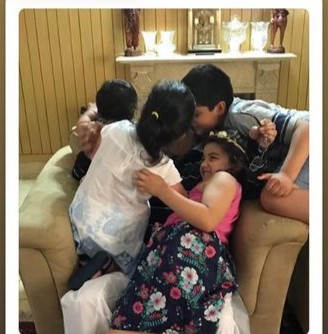 It was slow going at first. My son radius of love was narrow at that point, restricted to a factor of two: his parents. His relationship with his grandparents, who he saw occasionally, can be best described as tolerable. My father-in-law worked to change that. First, he observed. The language we were using with him, what we did to make him giggle, and where we would draw firm. Next, he mirrored Sometimes I would hear him using the exact same phrases I had been doing a minute ago from the next room. And then he played. Not what he thought what my son should be playing but whatever he wanted to. Capitals of countries. Ok. Loony Tunes. Ok. Games of hide and seek. Fine. And most important of all, he was consistent disbursing the same special level quotient of love, patience and charm every time he visited. The same quotient in fact to each of is six grandchildren each of whom he made feel special in their own right. I think each of them thinks they were his favourite. [You are right, you were]
My son was smitten with his dada.
On the day we told him he died around four years ago, he sat down and penned the most beautiful, goodbye. Then sent as a series of whatsapp messages to his dada’s number convinced that his love would reach him wherever he was. Just as his had to him.
Autism awareness is rare to find in our communities. Acceptance even rarer still. Love and pride for an autistic child, nearly impossible.
In my father-in-law’s last visit to us we took him to his grandson’s primary school leaver assembly. It was one of the best years of my son’s schooling life. Dada got to see his grandson’s snail-eating pictures from a trip to France; hockey competitions and from watching his grandson play the antagonist in the school play. He got to hear what teachers had to say him and his class fellow and watch his grandson’s comments make the whole audience laugh out loud. At the end of it I remember him turning around to tell us how proud he was of our parenting. We never got to say anything in turn.
Autism awareness is rare to find in our communities. Acceptance even rarer still. Love and pride for an autistic child, nearly impossible. But where it exists it makes so much possible.

Zainab Kizilbash is a parent, writer, economist and founder of Our Small Wonders